
Finding Clayton Residents by Record
A name, street address, or past address calls for a different starting point. The Clayton residents directory is most useful when each lead goes to the office that created the record. The Johnston County tax and map tools connect an address to a parcel. Recorded deeds connect people to a transaction. The state voter lookup can confirm civic registration details when public access allows it. Older names often appear in the library, Heritage Center, or digitized directories. None of those sources is a complete household list, so compare dates and record types before treating a match as the same person.
Start with the most concrete item available. A property card may show a tax owner and a mailing address, but it does not establish who occupies the building. A voter result is a registration record, not a promise that a person still lives at that address. Recorded deeds show parties and legal descriptions, not every household member. That separation keeps a Clayton resident search useful without turning a public index into a claim it cannot support.
- Search the county tax portal or map viewer with a known address, owner name, or parcel number.
- Keep the parcel or PIN, physical address, tax mailing address, and legal description as separate notes.
- Use the tax owner as a lead in the Register of Deeds index, then inspect the recorded parties and document date.
- Use the state voter lookup or Johnston elections route for public registration and district information.
- For an older household, check the dated directory, newspaper, yearbook, obituary, census, or archive route that fits the period.
Clayton Records Offices and Rolls
Clayton is in Johnston County, but Smithfield is the county seat. That matters because deeds, taxes, court files, elections, and much of the county history trail sit with Johnston County offices rather than Town Hall. The town remains the source for local permits, cemetery information, meeting records, and library materials. For a street-by-street address sequence, use the Clayton street directory after identifying the correct record custodian.
Johnston County Register of Deeds
207 E Johnston Street
Smithfield, NC 27577
919-989-5160
Johnston County Tax Office
207 E Johnston Street
Smithfield, NC 27577
919-989-5130
Johnston County Board of Elections
205 S Second Street
Smithfield, NC 27577
919-989-5095
Note: A portal result is a lead, while the office that holds the original record controls certified copies, corrections, and redaction questions.
Clayton Parcel and MapClick Leads
The Johnston County Public Access landing page offers three first choices: Property Owner Name, Parcel Number, and Property Address. Its companion, MapClick, can also locate an owner, address, deed book and page, NC PIN, subdivision, township, city limits, ETJ, school district, and other map layers. A parcel is a defined piece of land. Its situs address is the physical location used for the property, while a tax mailing address can belong to someone elsewhere.
The first screen is only the start. Preserve the original street spelling, then test a variant if the search fails. County permit guidance uses a numeric house number and complete street name, without the direction or street type. MapClick can center a street when the number is unknown. The resulting tax card or map can supply a PIN, acreage, value, owner, mailing address, physical address, legal description, and links to related records. A tax owner remains a property lead, not a verified resident.
| Johnston portal control | Observed use | Clayton search value |
|---|---|---|
| Property Owner Name | First-stage method option | Finds tax-owner parcel leads. |
| Parcel Number | First-stage method option | Connects a known PIN to a property card. |
| Property Address | First-stage method option | Finds a situs-address lead. |
| Basic Search / Sales Search | Separate portal paths | Provides parcel or sales-history starting points. |
Johnston County Public Access starts with those property methods.
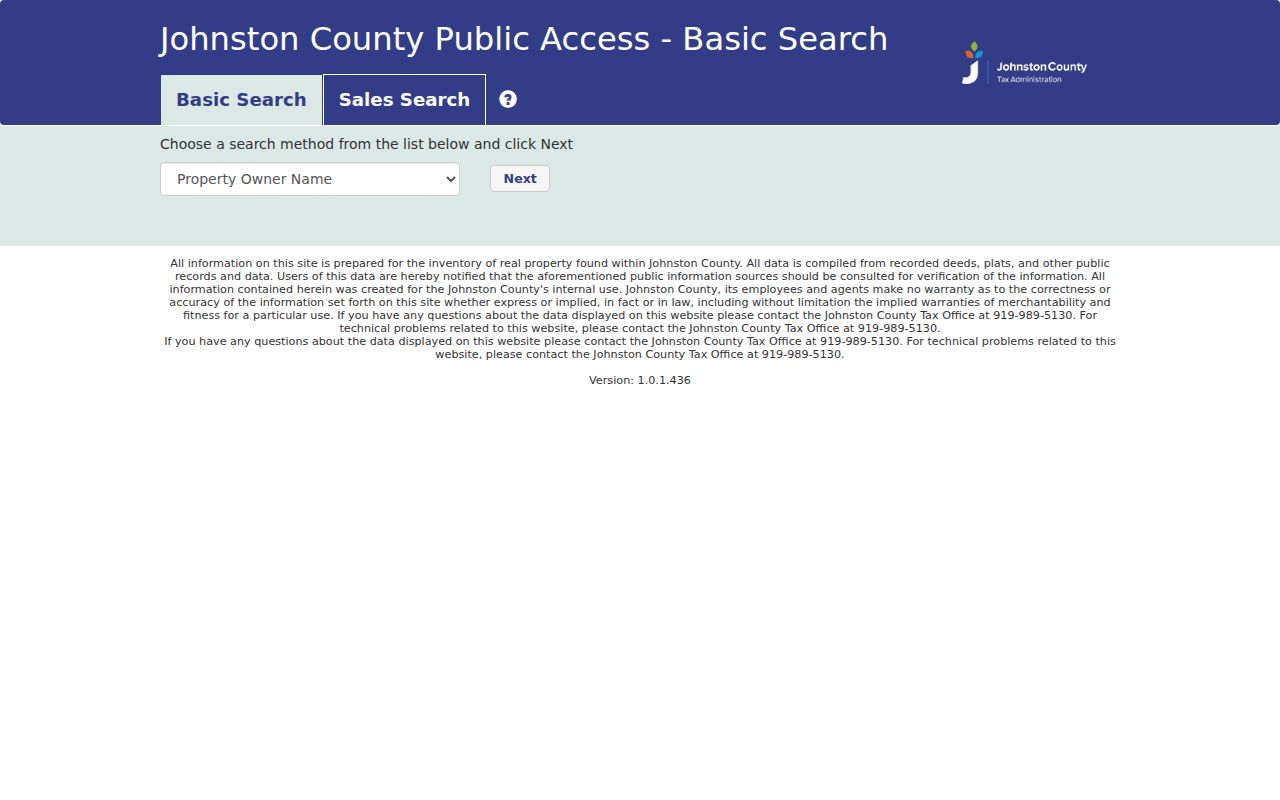
The screen shows why an address, owner name, and parcel number should be saved together before moving to deed or map records.
Clayton Deed Index Connections
The Register of Deeds uses EagleWeb for recorded instruments. Search a current tax owner as a grantee first, then inspect the most recent conveyance. The seller may become the next person to search. Continue only while the legal description, lot, subdivision, book or page, and date support the connection. EagleWeb supports grantor, grantee, reception number, date range, and document-type searches. Its related-document feature can link instruments that share a description or reference.
A recorded index is not a title opinion and it does not prove occupancy. A deed of trust, easement, release, plat, or power of attorney has a different purpose from a deed. Record the reception number, recording date, document type, parties, book or page when shown, legal description, and related document details. The online start date is not stated. For earlier Johnston material, the Heritage Center lists deed microfilm from 1759 through 1947 and should be contacted before travel because some material is offsite or non-circulating.
- Grantor
- The person or entity transferring an interest in a recorded instrument.
- Grantee
- The person or entity receiving that recorded interest.
- Index
- A searchable list of recorded entries, which can lead to an image or a copy request.
- Legal description
- The lot, plat, metes, or other formal land description used to match a transaction to a parcel.
EagleWeb is the public entry point for Johnston recorded documents.
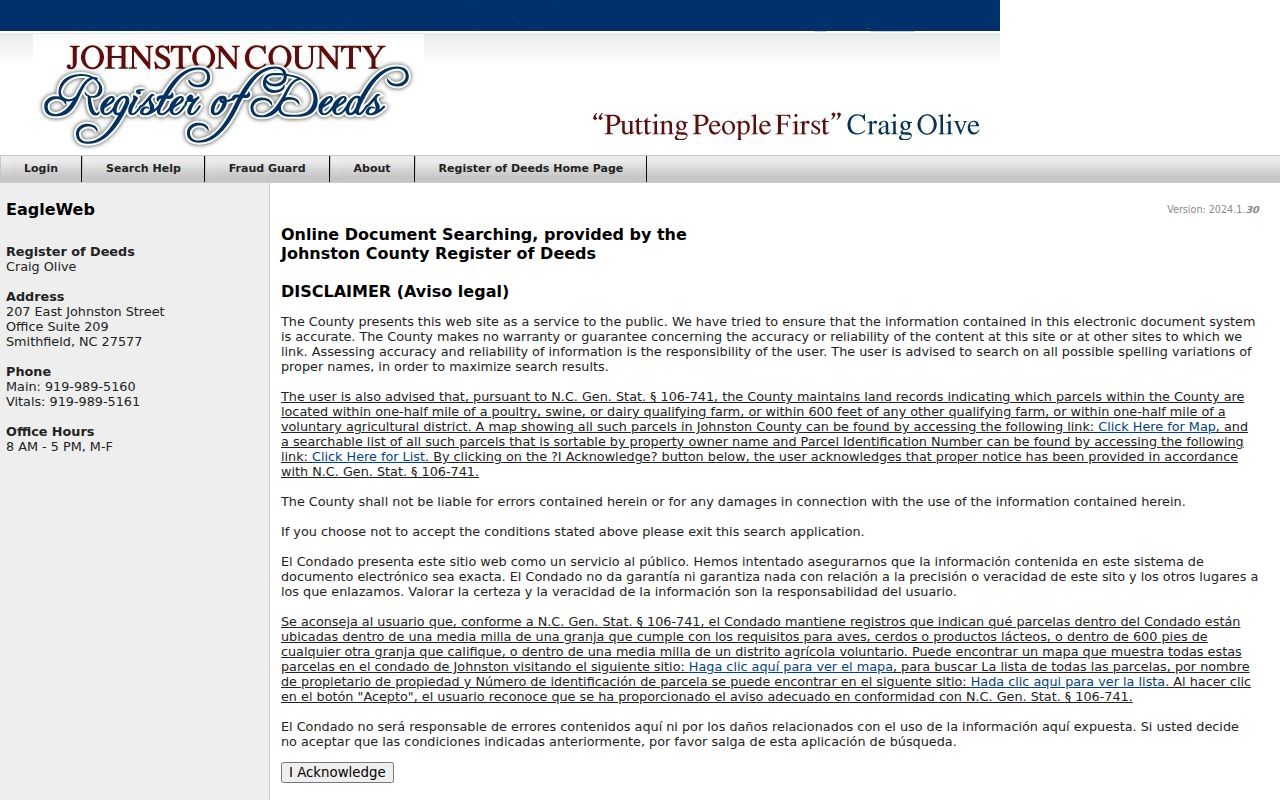
The grantor, grantee, reception number, date, and type controls support a recorded-document trail rather than a general household roster.
Current Clayton Resident Directory Sources
Current resident-directory evidence is split among records that answer narrow questions. The tax card is strongest for property-tax ownership. The voter route is strongest for public registration status and election jurisdictions. The deed index documents recorded parties. None should be stretched into proof about people who are not named in the record. A one-person search should compare sources by date and role.
| Clayton source | What it may list | Custodian | Access channel |
|---|---|---|---|
| Tax parcel and property card | Tax owner, parcel, situs and mailing addresses | Johnston Tax Office | Public portal, Tax Office help |
| Voter registration | Status, party, precinct, districts, polling details | State and Johnston elections offices | Name lookup, public files, county request form |
| Recorded instruments | Grantors, grantees, dates, legal descriptions | Johnston Register of Deeds | EagleWeb, office copies, Heritage microfilm |
| Town permit records | Address-keyed project and inspection leads | Clayton or county departments | Public permit search or custodian request |
| Local history collections | Dated households, schools, deaths, events | Library and Heritage Center | Digital collections, reading room, research request |
Clayton Voter Lookup Boundaries
The North Carolina voter lookup asks for first and last name, with optional middle initial, year of birth, and county. Its status controls include Registered, Removed, and Denied. Johnston County information says a result can return registration status, party, county, precinct, municipality, several districts, polling place, sample ballot, absentee status, and voting history or method. The public file excludes full birth date, Social Security number, driver-license information, and similar identifiers. Protected voters and addresses are handled under separate rules.
Use a voter result as a dated civic record. It can help distinguish people with the same name or confirm the correct election jurisdiction. It cannot show a secret ballot choice, every person in a household, or guaranteed current occupancy. The county request form offers registration, history, and statistics requests with scopes including municipal, precinct, ward, and district choices, but the research did not capture its lower-page delivery, fee, or certification fields.
The state voter lookup shows the name and status controls used for a public search.
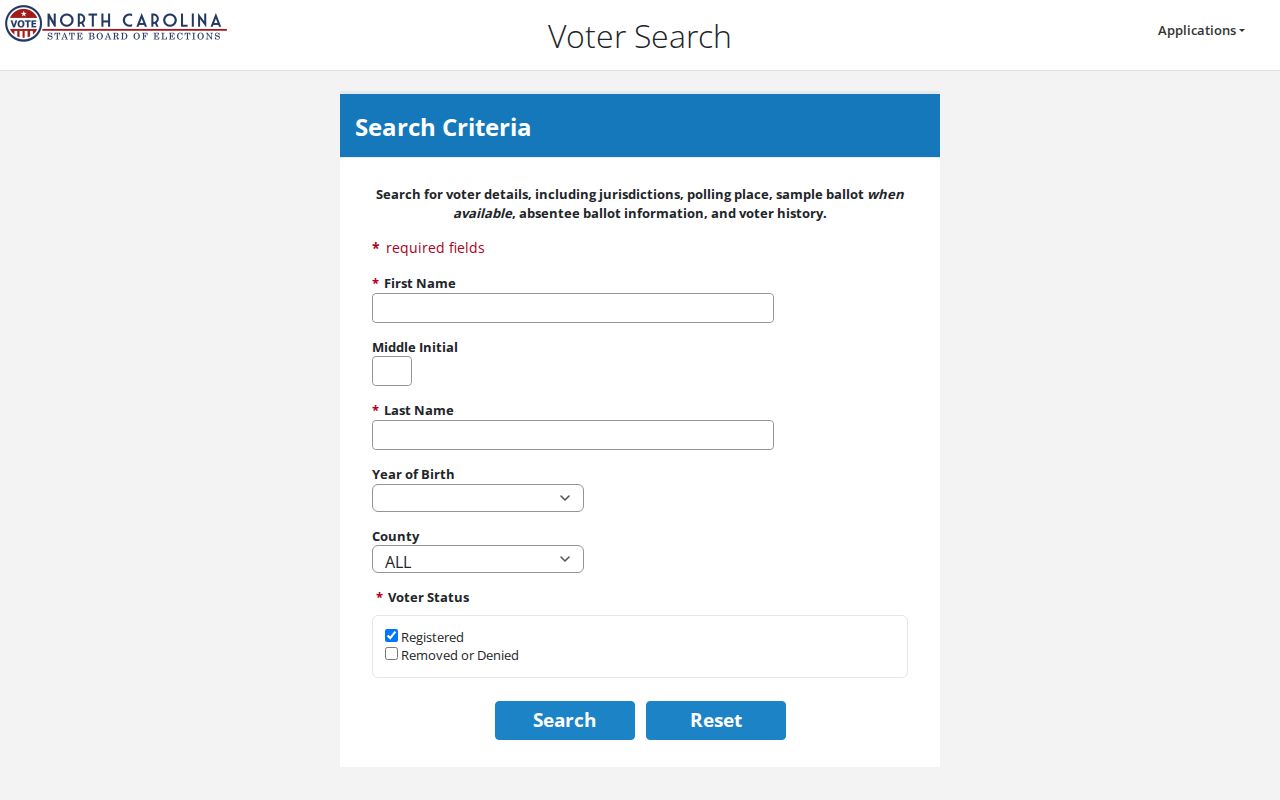
The optional county and year fields are useful for narrowing a common name without publishing sensitive identifiers.
Clayton Court and Clerk Records
A court case can offer a name, party role, case number, case type, events, hearing entries, disposition, or judgment. North Carolina eCourts reached statewide implementation on October 13, 2025, and the public portal is the first online route for public case leads. It is not a certified record. Juvenile, sealed, expunged, and other confidential matters may be absent. The Johnston County Clerk of Superior Court remains the source for court files, estate and special-proceeding material, divorce records, certified court copies, and courthouse access.
For a county-specific certified criminal name search, North Carolina uses form AOC-CR-314 through the Clerk, with a reported $25 fee. A case lead must be checked for the right person and final disposition. An arrest or jail entry is not a conviction finding. Estate files can be useful for heir research, but a recorded deed and an obituary or cemetery record should still be compared before treating a relationship or address as settled.
North Carolina eCourts Portal provides the public case-search entry.
The portal is a case-information lead, while certified copies and explanations belong with the Johnston Clerk.
Clayton Vital Record Routes
Birth, death, marriage, and divorce records have separate custodians and access rules. Johnston Register of Deeds holds local marriage licenses and locally held vital copies. North Carolina Vital Records covers statewide holdings beginning with births in 1913, deaths in 1930, marriages in 1962, and divorces in 1958. The date and record type should be named before choosing a county, state, Clerk, Archives, or library route. A research lead, scanned image, uncertified copy, and certified copy are not interchangeable.
| Birth or death | Use Johnston ROD for locally held copies or the state route; certified access follows G.S. 130A-93 eligibility rules. |
|---|---|
| Marriage | Johnston ROD holds county license and copy routes; historical indexes may also lead to Heritage material. |
| Divorce | Use the Johnston Clerk for the court file and the state route for eligible vital-certificate requests. |
| Older family history | Pair county and state routes with obituaries, cemeteries, newspapers, and archive collections. |
Note: A public name in an index does not make a certified certificate available to every requester.
Historical Clayton Resident Directories
Clayton’s historical record shelf is regional rather than one complete Clayton-only run. DigitalNC has a 1947 Johnston County City Directory and Hill’s Smithfield-Selma / Johnston County items from 1957, 1959, 1961, and 1963. Those volumes can include Clayton and rural-delivery entries, but geography must be read on each page. A directory entry may show a name, address, residence marker, relationship notation, occupation, employer, phone, or business listing. Scan images deserve a close check because OCR can misread initials, abbreviations, and street numbers.
DigitalNC also offers Clayton News and Clayton News-Star issues from 1914 through 1969. The Hocutt-Ellington Memorial Library points researchers to local newspapers, yearbooks, cemetery material, Sanborn Maps, HeritageQuest, and other local-history resources. The full collection details and reading method belong in the Clayton city directory research path. For a historic household, preserve the volume title, year, page, exact address, and any abbreviation instead of silently expanding a mark such as r.
DigitalNC’s 1947 Johnston directory supplies a digitized, downloadable example.
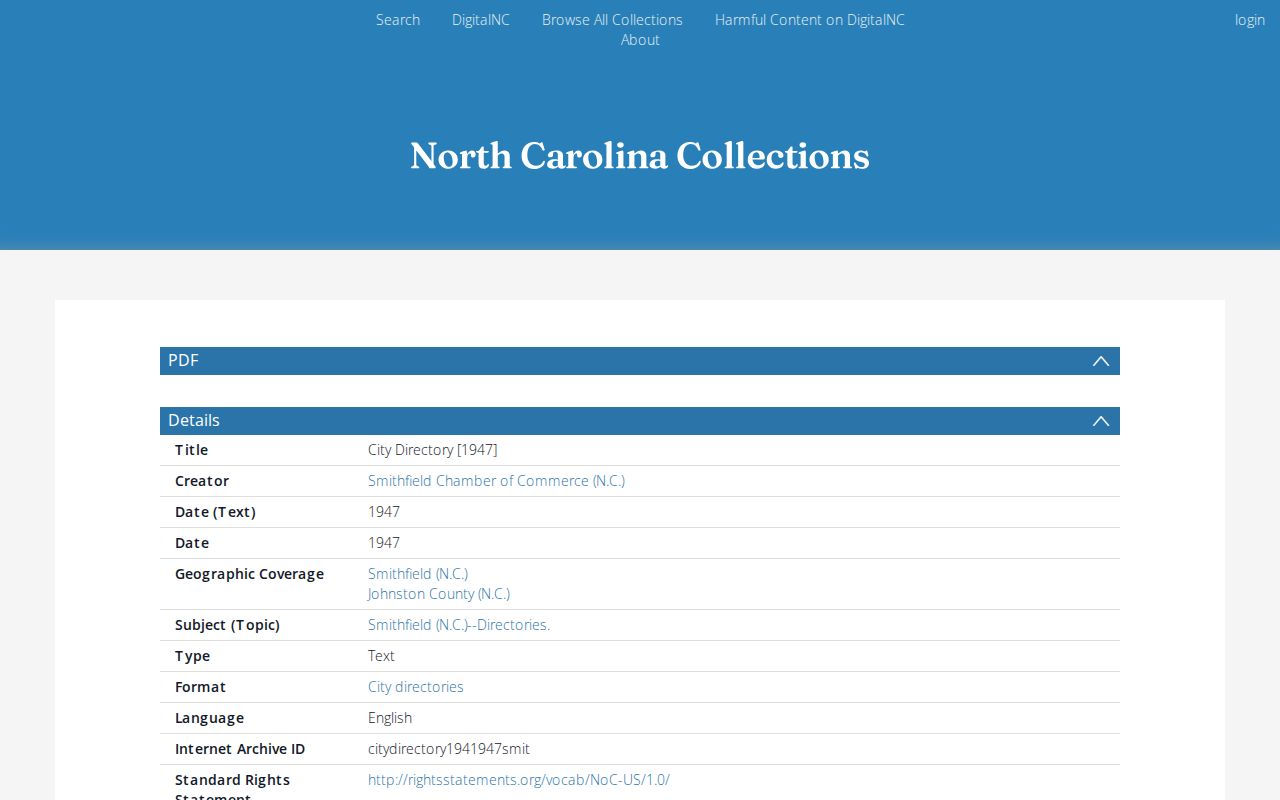
A dated scan can connect a household to a place and time, but it should be checked with the page image and another record.
Clayton Before the Town Name
Clayton incorporated in 1869, and earlier material may use Stallings’ Station, Clayton Township, a precinct, rural delivery, or a nearby community instead. That place-name shift is a practical research tool. A nineteenth-century deed, newspaper, or family paper may not be indexed under the modern town name. Search the period name alongside Clayton, then compare the land description, township, date, and nearby institution before deciding it refers to the same place.
The 1902 North Carolina yearbook offers a compact civic picture of Clayton, including town officers, a postmaster, a railroad and express agent, churches, school, banks, merchants, physicians, and Clayton Cotton Mills. It is a snapshot, not a full residents directory. Its value is in naming institutions that may lead to a newspaper notice, directory listing, church material, cemetery reference, or archive collection from the same period.
Clayton Records Access and Safety
North Carolina’s Public Records Act, Chapter 132, generally permits inspection of public records without a stated purpose, but it does not require an agency to create a new compilation. Agencies may separate confidential portions, and some requests involve actual-copy costs or special service charges. Vital certificates, protected voter addresses, juvenile and sealed matters, adoption records, motor-vehicle information, military discharges, and sensitive account or identity fields follow more specific limits.
Use Clayton and Johnston records for a lawful personal purpose. Do not use a public record to target, harass, expose, or endanger another person, and do not try to defeat a protected-address program.
North Carolina’s Address Confidentiality Program gives eligible survivors a substitute-address route under Chapter 15C. G.S. 132-1.10 provides a redaction route for listed sensitive identifiers in Register of Deeds and Clerk documents. If a record seems wrong, ask the Tax Office, Register of Deeds, Board of Elections, Clerk, or issuing agency about its own correction process. A records request should seek an existing record from the correct custodian, not ask the office to find a private person.
Clayton’s Newer Records Tools
Several local resources changed recently. Johnston MapClick moved to a new server in July 2026, and its manual describes locate, query, select, report, and parcel-buffer tools. Clayton’s Permit Clayton Hub opened public access to more than 20 permit and submittal record types in July 2026, adding address-keyed municipal records such as zoning verification, tree clearing, floodplain, sign, driveway, development, wastewater, and transportation items. Search the named record type and address, then ask the department for older or unavailable material.
The library also announced a March 2026 obituary index built from funeral records, donated collections, and vertical files, followed by an April 2026 notice about the DigitalNC newspaper run. These are finding aids, not certified vital records. They can bridge a family-history gap when a modern portal has no useful result. Request or inspect the original item before relying on a date, burial location, relationship, or address.